How to Structure Content So AI Search Engines Cite You as the Primary Source
Introduction
Search is evolving rapidly.
Traditional SEO focused on helping websites rank on search engine result pages. But today, millions of users are turning to AI platforms like ChatGPT, Gemini, Copilot, Perplexity, and other generative search engines to get direct answers instantly.
Instead of browsing multiple links, users now ask questions conversationally and receive summarized responses.
That creates a major shift:
If AI gives the answer directly, will your website be mentioned as the trusted source?
This is where GEO (Generative Engine Optimization) becomes essential.
GEO is the process of optimizing your website and content so AI systems can understand, retrieve, trust, and cite your information when generating answers.
-----
What is GEO?
Generative Engine Optimization (GEO) is the next evolution of digital visibility.
It focuses on making your content perform well inside:
- AI search engines
- Conversational assistants
- Answer engines
- Voice AI systems
- Large Language Model (LLM) platforms
- Smart recommendation systems
Instead of optimizing only for clicks, GEO optimizes for:
- Being cited in AI answers
- Becoming a trusted source
- Increasing brand mentions
- Improving authority signals
- Winning zero-click visibility
-----
GEO vs Traditional SEO
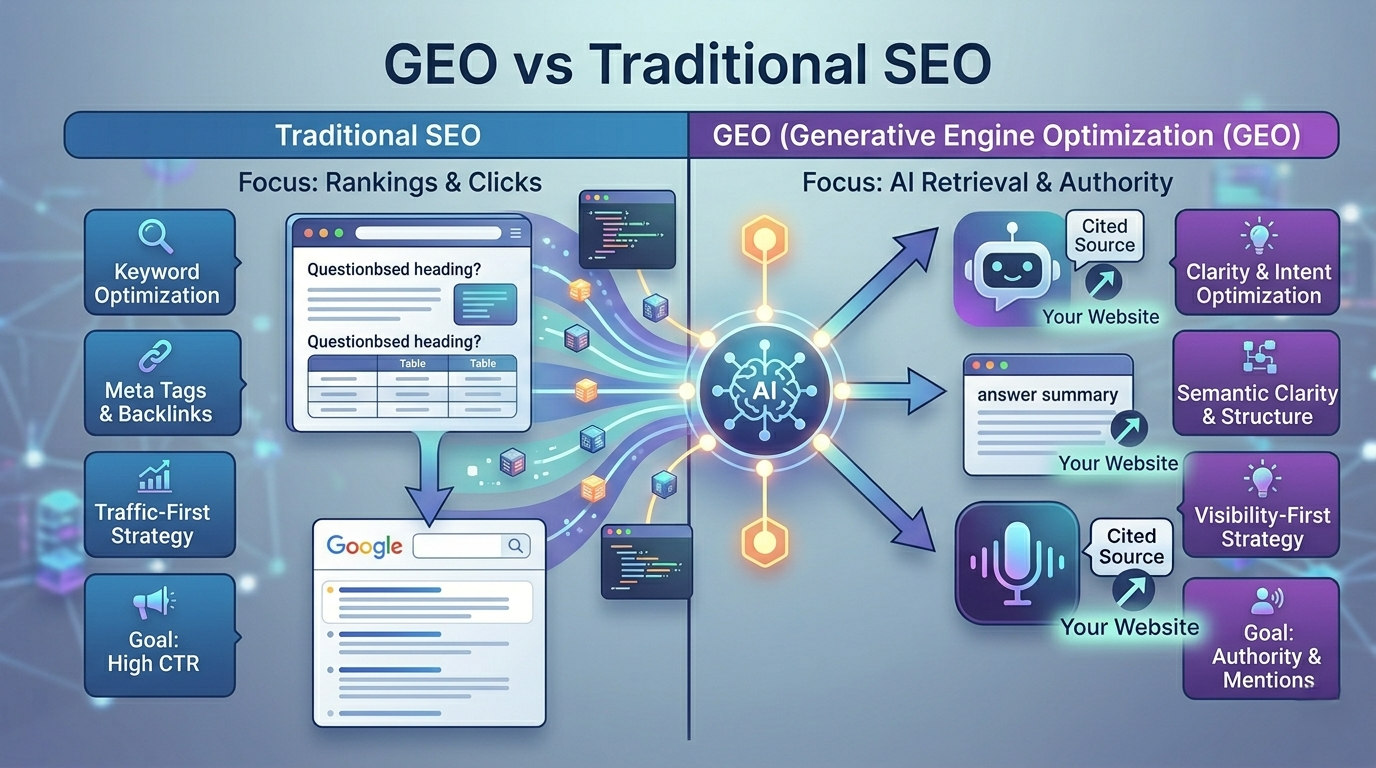
| Traditional SEO | GEO |
|---|---|
| Rank pages in search results | Get cited in AI-generated answers |
| Optimize keywords | Optimize clarity + intent |
| Focus on backlinks | Focus on authority + structure |
| Increase CTR | Increase mentions + trust |
| Meta tags matter | Semantic clarity matters |
| Traffic-first strategy | Visibility-first strategy |
-----
Why GEO Matters in 2026 and Beyond
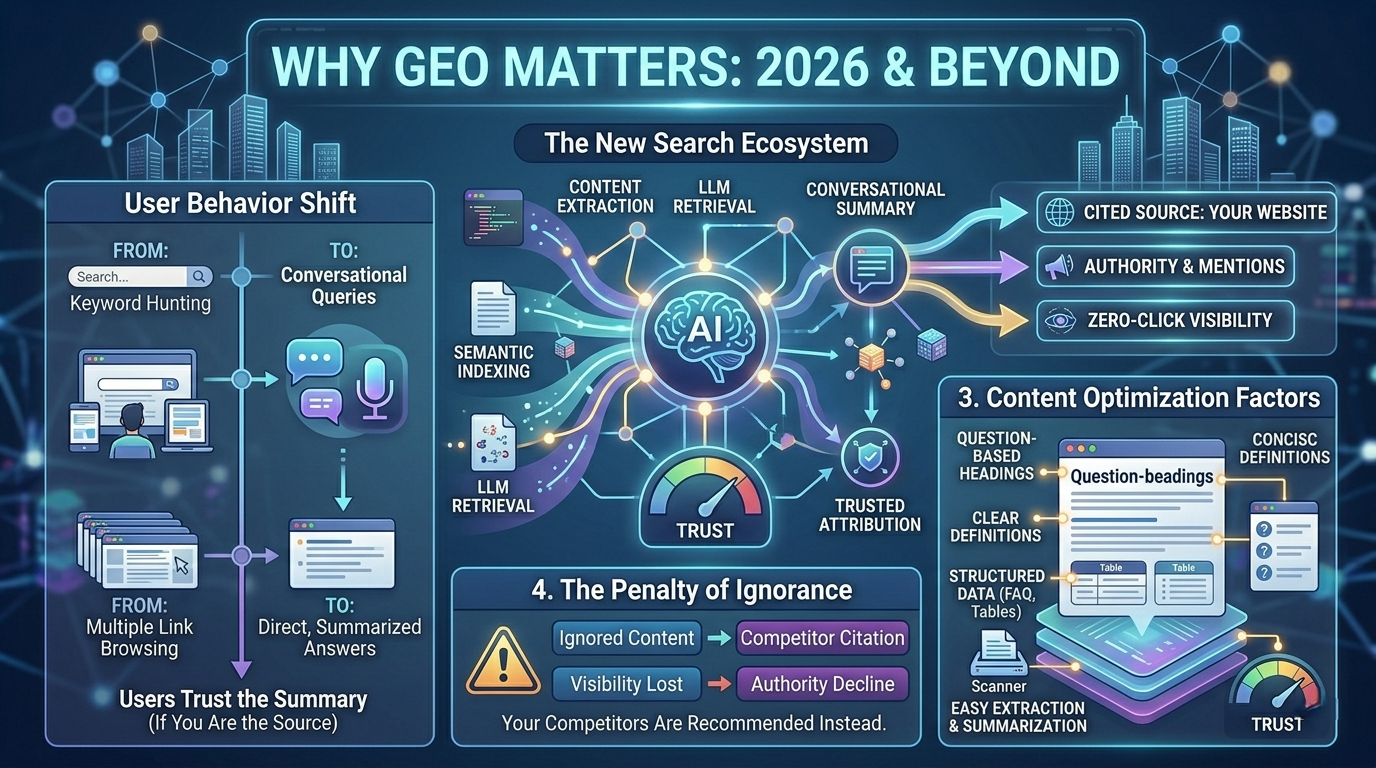
User behavior has changed.
People now search like this:
- Best CRM for startups
- How OAuth login works
- What is vector database
- How to learn React quickly
- Cheapest cloud platform for SaaS
- Best AI tools for marketing
Instead of opening ten websites, many users trust the AI-generated summary.
That means:
If your content is not optimized for AI retrieval, your competitors may be recommended instead.
-----
How AI Search Engines Choose Sources
AI systems usually favor content that is:
1. Clear
Direct and concise explanations.
2. Structured
Headings, bullet points, tables, FAQs, sections.
3. Trustworthy
Accurate, updated, expert-level information.
4. Specific
Concrete answers outperform vague writing.
5. Easy to Extract
Well-organized content is easier for AI systems to summarize and cite.
-----
Core GEO Strategies
1. Answer First, Explain Later
Do not hide the answer behind long introductions.
Weak Example
Many businesses struggle with customer acquisition in a competitive market...
GEO Example
Email marketing remains one of the highest ROI channels for customer retention and repeat sales.
Then expand with details.
-----
2. Use Question-Based Headings
Structure headings based on real search prompts.
## What is OAuth?
## How does JWT authentication work?
## Best CRM for startups?
## React vs Vue in 2026
## How does GEO improve AI visibility?
This increases relevance for AI systems.
-----
3. Write Clear Definitions
AI systems prefer concise definitions.
A vector database is a database designed to store and search embeddings using similarity search algorithms.Simple, direct, reusable.
-----
4. Add Comparison Tables
Tables help AI summarize quickly.
| Tool | Best For | Complexity |
|---|---|---|
| React | Dynamic UI apps | Medium |
| Vue | Fast projects | Low |
| Angular | Enterprise systems | High |
-----
5. Use Step-by-Step Sections
Example:
## How OAuth Login Works

1. User clicks login
2. Redirect to identity provider
3. User grants permission
4. Provider returns authorization code
5. App exchanges code for token
6. User is authenticated
AI models love structured sequences.
-----
6. Add FAQ Sections
## FAQ

### Is GEO replacing SEO?
No. GEO complements SEO.

### Can AI citations drive traffic?
Yes. They improve brand trust, mentions, and discovery.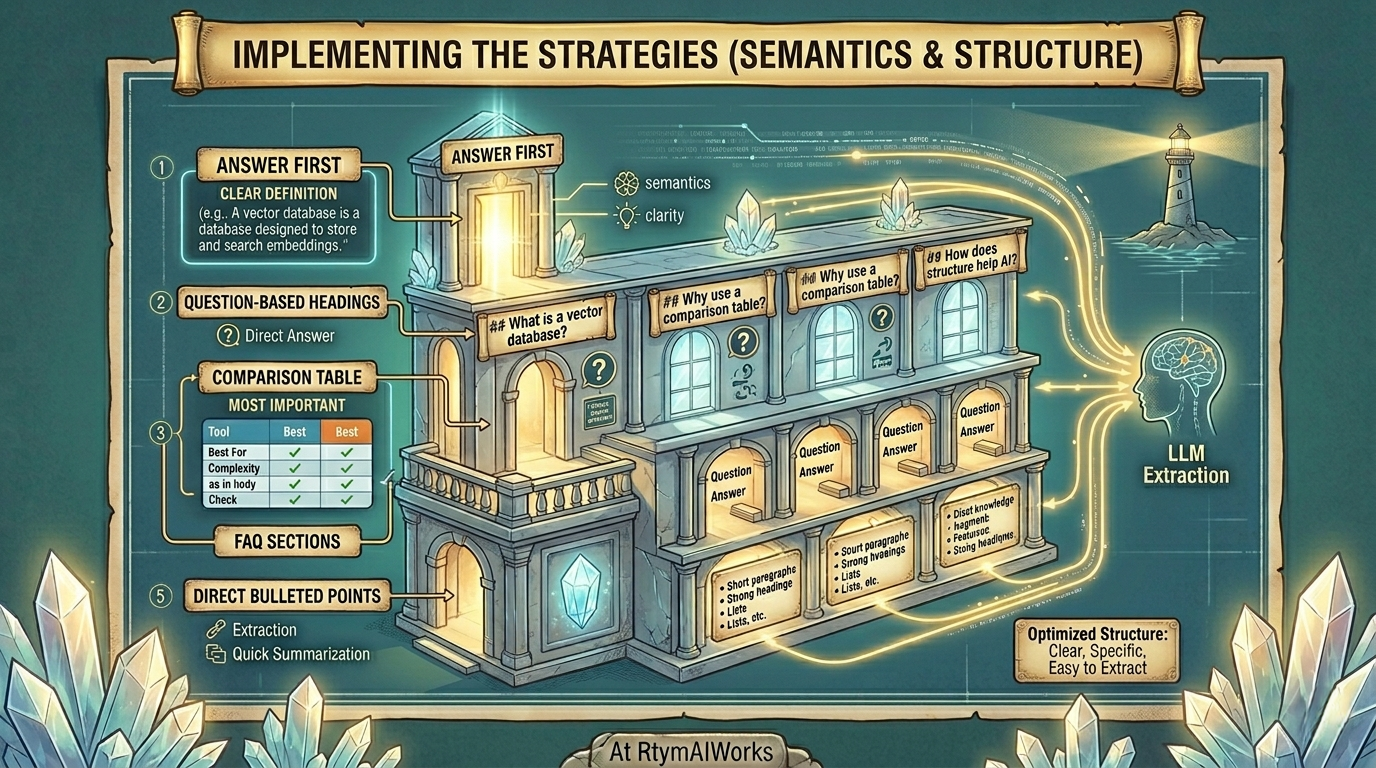
Best GEO Blog Structure
Use this layout for modern content:
# Main Title

## Quick Answer

## What is It?

## Why It Matters

## How It Works

## Benefits

## Comparison

## Step-by-Step Guide

## Common Mistakes

## FAQ

## Final Verdict
-----
GEO Writing Rules
Use:
- Short paragraphs
- Strong headings
- Bullet lists
- Tables
- Definitions
- Examples
- Updated facts
- Expert insights
Avoid:
- Keyword stuffing
- Long filler intros
- Clickbait titles
- Hidden answers
- Vague statements
- Unstructured walls of text
-----
Example: GEO Optimization
Topic: JWT Authentication
Weak Content
Authentication is an important part of modern software systems...
GEO Optimized Content
JWT authentication uses signed tokens to verify users without storing server-side sessions.
Then explain:
- Header
- Payload
- Signature
- Token lifecycle
- Advantages
- Security best practices
-----
GEO for Developers
Developers should create content such as:
- Spring Security JWT Guide
- OAuth 2.0 Explained Simply
- Docker vs Kubernetes Comparison
- MERN Deployment Guide
- How RAG Works
- Vector Database Tutorial
- WebAuthn Passkey Authentication Guide
Technical content performs strongly in AI systems when structured properly.
-----
GEO for Businesses
Businesses should optimize:
Product Pages
Explain what problem you solve.
Service Pages
Who it is for, process, outcomes, pricing logic.
Local Pages
Location + trust signals + clear services.
Case Studies
Real results and measurable outcomes.
Knowledge Hubs
Educational resources around your niche.
-----
GEO for Personal Brands
Create authority content such as:
- Tutorials
- Frameworks
- Industry insights
- Opinion pieces
- Original concepts
- Trend breakdowns
When AI repeatedly cites your name or brand, authority compounds over time.
-----
How to Measure GEO Success
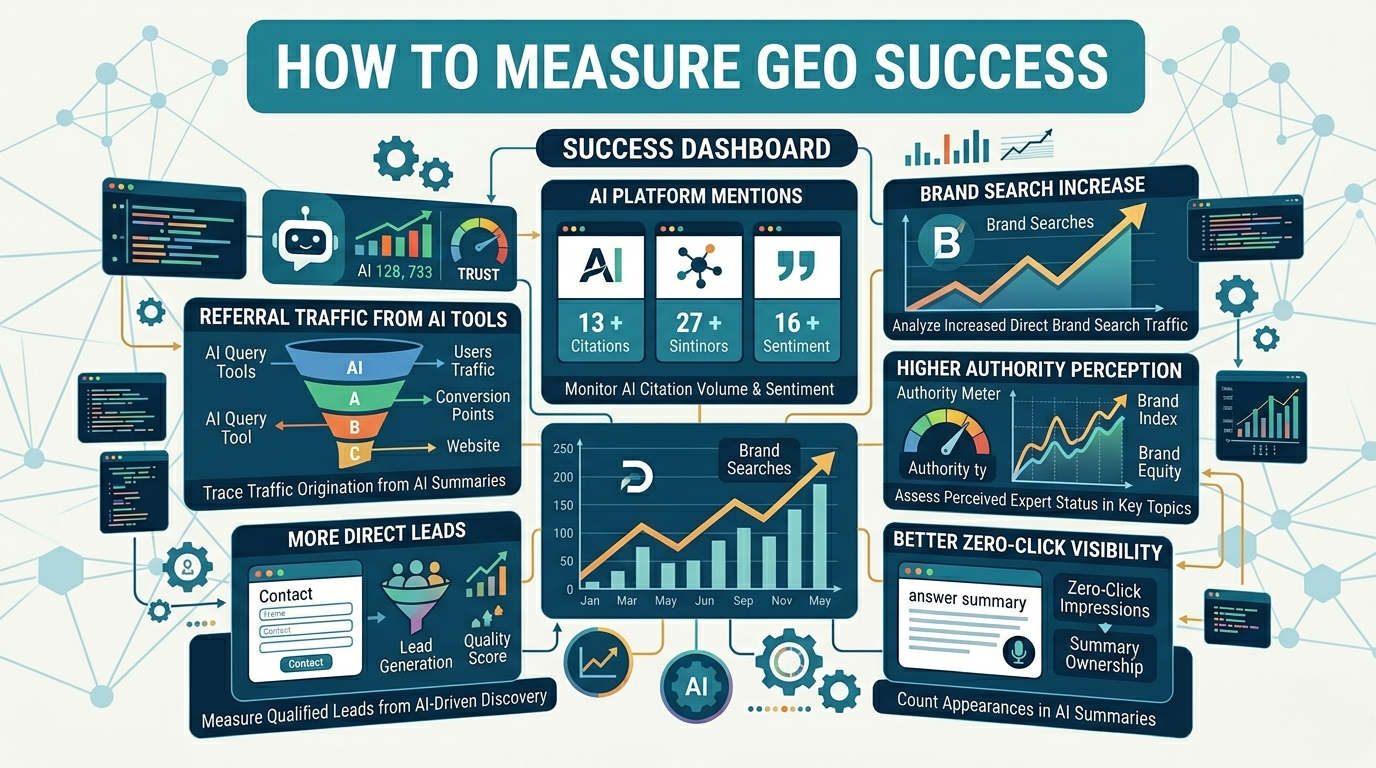
Track:
- AI platform mentions
- Brand searches increasing
- Referral traffic from AI tools
- Higher authority perception
- More direct leads
- Better zero-click visibility
-----
Future of GEO
Every brand will soon optimize for two ecosystems:
Human Search
Google, Bing, DuckDuckGo
AI Search
ChatGPT, Gemini, Copilot, Perplexity, future assistants
Early adopters gain trust first.
-----
GEO Optimization Checklist
Before publishing, ask:
- Does the intro answer directly?
- Are headings question-based?
- Is the content easy to scan?
- Are tables included?
- Is data current?
- Is expertise visible?
- Can AI quote this easily?
- Does the page solve intent fast?
If yes, it has strong GEO potential.
-----
Final Thoughts
SEO helped websites get discovered.
GEO helps websites get cited.
The next generation of digital growth is not only about rankings.
It is about becoming the trusted source AI systems rely on.
If SEO was about clicks, GEO is about credibility.
-----
Quick Summary
GEO = Generative Engine Optimization
Optimize your content so AI systems:
- Understand it
- Trust it
- Retrieve it
- Quote it
- Cite your brand
Those who structure knowledge best will dominate visibility in the AI era.
-----
Add This Service to Your Website with At RtymAIWorks
Want your website ready for AI search visibility?
At RtymAIWorks, we help businesses implement GEO strategies so AI engines understand, trust, and cite your website as a primary source.
Our GEO Services Include:
- GEO-ready website content architecture
- AI citation optimization
- Blog restructuring for ChatGPT, Gemini, Copilot, Perplexity
- SEO + GEO hybrid growth strategy
- Semantic content optimization
- Knowledge base development
- Technical authority content creation
- AI visibility audits
Ideal For:
- Startups
- SaaS products
- Agencies
- E-commerce brands
- Personal brands
- Developers launching products
Why Choose RtymAIWorks?
We build systems for future-proof discoverability.
If users ask AI about your industry, your business should be part of the answer.
Get Started
At RtymAIWorks, we help brands grow in the age of AI-first search.
Transform your website into an AI-citable authority source.