Google Gemini 3.8 Flash & 3.8 Flash Cyber: The Ultimate Deep-Dive Guide
Executive Summary: Google’s Rapid Leap to Workhorse Autonomy
Just weeks after rolling out previous iterations, Google has introduced Gemini 3.8 Flash alongside a dedicated, security-hardened defensive variant: Gemini 3.8 Flash Cyber.
Positioned as Google’s most capable reasoning and coding models in the Flash tier, Gemini 3.8 bridges the gap between ultra-low-latency API inference and multi-step, frontier-grade autonomy. Instead of relying purely on parameter-bloated flagship models, Google has engineered Gemini 3.8 to "work harder" by chaining thoughts, querying tools repeatedly, and executing long-horizon tasks at a fraction of standard frontier pricing.
In this deep dive, we break down:
- Core architectural innovations in Gemini 3.8 Flash (tunable effort levels, agentic looping, and cross-domain reasoning).
- Gemini 3.8 Flash Cyber and why it sets a new precedent in autonomous vulnerability discovery and automated patching.
- The Fairwind Program: Defensive-first AI deployment and strict access guidelines.
- Key Benchmark Results: DeepSWE, CWE-Bench, CyberGym, Vals Finance Agent, and Harvey Legal.
- Real-World Impact & Migration Strategy: When to upgrade from 3.7 Flash and how to implement it today.
1. What Makes Gemini 3.8 Flash Different?
Most "flash" class models historically prioritized token generation speed and raw efficiency over deep, cyclic reasoning. Gemini 3.8 Flash fundamentally flips this paradigm by turning the Flash architecture into an autonomous execution engine.
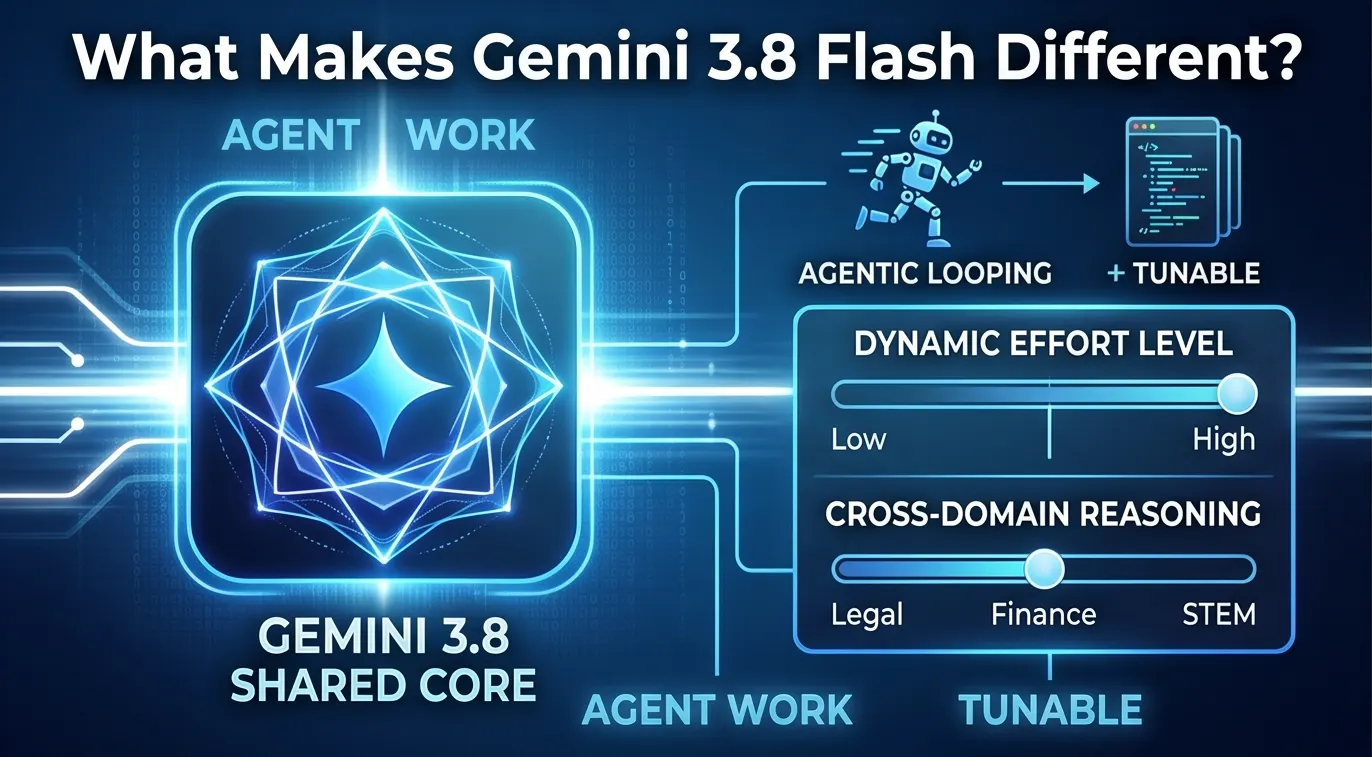
Key Architectural Upgrades:
- Dynamic / Tunable Effort Levels: Developers can configure inference effort dynamically. At lower effort tiers, 3.8 Flash minimizes token overhead for latency-critical tasks (chat, streaming UIs). At higher effort tiers, the model initiates recursive reasoning chains, re-inspects code paths, and iterates through unit tests before returning output.
- Long-Horizon Problem Solving: Built specifically for autonomous development environments like Google Antigravity and Google AI Studio, 3.8 Flash can take a single overarching prompt (e.g., building a complete retro DOS Google Maps client or Three.js hardware teardown visualizer) and iteratively code, debug, and assemble multi-file projects.
- Domain Reliability (Legal, Finance, STEM): Unlike typical coding-centric models that hallucinate in specialized compliance environments, Gemini 3.8 Flash demonstrates dramatic uplifts across Harvey's Legal Agent Benchmark and Vals Finance Agent V2, making it suited for contract audits and quantitative financial reporting.
2. Gemini 3.8 Flash Cyber: A Paradigm Shift for Cybersecurity
Historically, applying large language models to cybersecurity was restricted by inference cost. Exploring an expansive codebase search space requires hundreds of passes across thousands of files. Flagship models are too slow and cost-prohibitive for large-scale commit scanning.
.webp)
Gemini 3.8 Flash Cyber changes the economic and technical calculus by combining lightweight Flash token pricing with frontier-grade vulnerability discovery and automated remediation.
The Defensive Focus: "Patching Over Exploitation"
Under Google's Frontier Safety Framework, 3.8 Flash Cyber has been optimized to prioritize vulnerability fixing rather than exploit development.
- Autonomous Vulnerability Discovery: Evaluated on the industry-standard CyberGym benchmark, 3.8 Flash Cyber outperforms both previous cyber iterations and several significantly larger frontier models.
- Automated Patch Synthesis: On CWE-Bench (run by Collinear), 3.8 Flash Cyber achieved a 47.2% pass@1 rate, landing right on the Pareto frontier next to industry-leading flagship models (47.8%) at a small fraction of the cost.
Real-World Case Studies:
- Google Chrome Security Team: Replaced larger commercial engines with 3.8 Flash Cyber, yielding 2.6x more correct patches for complex browser vulnerabilities.
- Cloud Security Firm Wiz: Recorded a +7.5% to +9.7% higher recall in penetration testing benchmarks alongside a 2.3x to 5.2x reduction in cost.
- Google Cloud Vulnerability Research: Identified a critical foundational infrastructure flaw in under 2 hours—a research timeline that routinely requires weeks or months of manual fuzzing and reverse engineering.
3. The Fairwind Program: Responsible AI Deployment
.webp)
Given the dual-use capabilities of advanced security tooling, Google has established a clear boundary between general deployment and high-assurance defense:
| Feature Dimension | Gemini 3.8 Flash | Gemini 3.8 Flash Cyber |
|---|---|---|
| Availability | Public API, Google AI Studio, Gemini App (Pro/Ultra), Enterprise | Restricted via Fairwind Program |
| Target Audience | Software engineers, enterprise developers, quantitative researchers | Trusted defenders, critical infrastructure teams, government orgs, OSS maintainers |
| Safety Mitigations | Strict CBRN & Cyber-offensive guardrails (Frontier Safety Framework) | Permissive cyber-analysis mitigations tailored for deep inspection & patching |
| Injection Defense | Hardened against prompt injection attacks (verified via Gray Swan benchmarks) | Hardened against prompt injection & adversarial repository jailbreaking |
Through the Fairwind Program, Google ensures that frontline defenders, infrastructure maintainers, and public-sector cybersecurity units retain an asymmetrical advantage against malicious actors.
4. Benchmark Scorecard
| Benchmark | Focus Domain | Gemini 3.8 Flash / Cyber | Prior Standard / Frontier Comparison |
|---|---|---|---|
| CWE-Bench (Pass@1) | Automated Vulnerability Patching | 47.2% (3.8 Flash Cyber) | 47.8% (Frontier Flagships at 5x+ cost) |
| DeepSWE v1.1 | Long-Horizon Software Engineering | Tier-1 Outperformance | Outperforms standard frontier models |
| HLE-Verified | High-Level Multi-Step Reasoning | 54.9% | Significant jump over 3.7 Flash |
| CyberGym | Real-World Vulnerability Identification | Frontier-Leading | Beats 3.5 Flash Cyber & large LLMs |
| Chrome Patching Recall | Large Codebase Browser Patches | 2.6x Increase | Outperforms previous frontier baselines |
| Wiz Pentest Benchmark | Vulnerability Detection Recall | +7.5% to +9.7% Recall | 2.3x–5.2x lower total operational cost |
5. Cost vs. Performance: Should You Upgrade from 3.7 Flash?
.webp)
A critical insight highlighted by early testing and third-party analysts (such as Artificial Analysis) is that while per-token API prices remain identical to 3.7 Flash, the effective token volume shifts:
- Token Consumption Increases Under Higher Effort: Because 3.8 Flash "works harder"—chaining tool calls and synthesizing multiple internal attempts—total tokens per complex task can rise by ~30% to 40%.
- Cost vs. Outcome Efficiency: While aggregate token consumption may increase on complex coding workflows, the cost per solved problem drops dramatically compared to invoking monolithic flagship models (like Claude 3.5/3.7 Sonnet or GPT-4o/o1).
- When to Stay on Gemini 3.7 Flash: For simple query routing, standard high-throughput summarization, or basic chat tasks where multi-step verification isn't required, 3.7 Flash remains cost-optimal.
- When to Switch to Gemini 3.8 Flash: For multi-file code editing, continuous integration/commit bots, agentic workflows (Antigravity/Stitch), and high-stakes legal/financial data reconciliation.
6. How to Get Started Today
- Developers: Available now via the Gemini API in Google AI Studio, Google Antigravity, and Android Studio.
- Enterprise: Accessible through Gemini Enterprise with enterprise-grade SLA and zero-data-retention options.
- Consumers: Active for Google AI Pro and Ultra subscribers inside the Gemini app, Google Search AI Mode, and Google Sheets.
- Cybersecurity Defenders: Apply for prioritized access to Gemini 3.8 Flash Cyber through the official Fairwind Program portal.
Frequently Asked Questions (FAQ)
What is the primary difference between Gemini 3.8 Flash and 3.8 Flash Cyber?
Gemini 3.8 Flash is a general-purpose, agentic workhorse model available to all developers. Gemini 3.8 Flash Cyber shares the same foundational weights but features specialized fine-tuning for vulnerability discovery and automated code repair, gated under the Fairwind Program for verified defenders.
Can Gemini 3.8 Flash replace larger frontier models for coding?
In benchmarks like DeepSWE v1.1 and internal evaluations (such as Google's Jetski coding comparisons), 3.8 Flash approaches or exceeds the performance of larger flagship models for autonomous multi-step software engineering, at substantially lower inference cost.
How does the tunable effort parameter work?
Developers can adjust the reasoning effort level via API parameters. Higher effort instructs the model to generate auxiliary reasoning traces and iteratively invoke code execution or search tools before outputting a solution, while lower effort delivers rapid responses with minimal token usage.
Build & Integrate Next-Gen AI Solutions
Looking to build autonomous AI agents, automated vulnerability triage pipelines, or integrate advanced reasoning models like Gemini 3.8 Flash into your existing web platforms and business workflows?
Reach out to Santhosh Shanmugam to consult, design, and deploy custom, production-grade AI architectures tailored to your application.